Nem TDoc 001
Xenonids
Parasitic species that convert biomass into resin hives, evolving from Larvae into Queens and Kings.
Nem TDoc 001
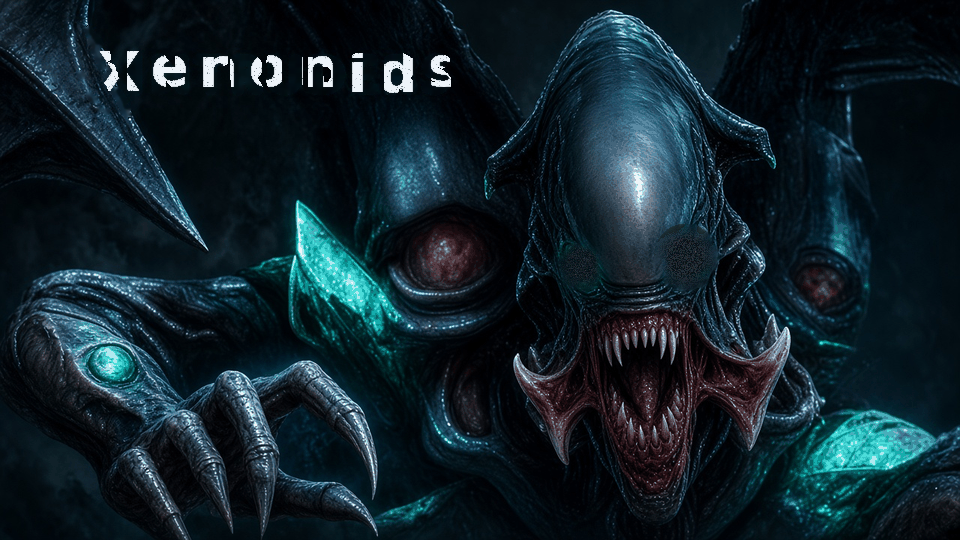
Technical data sheet (source): Nem TDoc 001 - Xenonids
Subject: Evolutionary Lifecycle of the Species Designated “Xenonids”
Author: Dr. Elara Gellar, Xenobiologist, Corporate Research Division
The organism designated “Xenonid” is a highly sophisticated parasitic species that spreads exclusively through infestation of living hosts and contamination of biomass. Lacking any independent interstellar travel capability, Xenonids rely entirely on unwitting carriers — whether living crew or contaminated cargo — to reach new star systems. Once established, they rapidly convert the local environment into a self-sustaining hive using secreted resin structures.
Xenonids exhibit traits of extreme adaptability and stealth. Their biology allows both rapid, violent conversion of hosts and long-term, nearly undetectable incubation. Every encounter carries risk: direct contact with living forms or contaminated surfaces may leave no immediate trace, yet the infection can bloom weeks or months later.
Key Environmental Hazards
Slime
A thick, high-viscosity secretion that coats surfaces, objects, and personnel. While largely inert, Slime serves as a biological marker. It significantly increases the probability of acquiring Contaminant from any nearby source and makes the affected individual far easier for Xenonids to detect. Marked subjects emit a distinct pheromone signature, rendering stealth or silent movement nearly impossible as the hive instinctively converges on their location.
Contaminant
The earliest and most insidious stage of the lifecycle. Contaminant consists of microscopic Xenonid genetic material — a living “DNA soup” — that can be absorbed through skin contact, inhalation, or ingestion of contaminated material. Subjects are immediately aware they have been exposed, but cannot determine whether the material will remain inert or coalesce into a viable Larva. The more times an individual accumulates Contaminant, the higher the probability that the genetic material will successfully integrate and begin rapid growth. This uncertainty makes Contaminant particularly dangerous for long-duration missions.
Lifecycle Stages
Stage 0 – The Nest
A pulsating, semi-sentient biomass mass that functions as both incubator and local command center. The Nest continuously secretes raw genetic slurry used to generate Eggs, Contaminant, and Slime. It grows by consuming available organic matter and serves as the anchor point for hive expansion.
Stage 1 – The Egg
Tough, leathery ovoid structures capable of surviving extreme conditions including vacuum and temperature fluctuations. When a suitable host is detected, the Egg opens and launches its payload with startling speed and precision. A single undetected Contaminant or Egg can transform an entire starship or facility into a teeming hive within hours. Their ability to spread undetected across interstellar distances through long-term incubation makes Xenonids one of the most persistent threats to human expansion.
Stage 2 – The Larva
A small, serpent-like organism whose sole purpose is host infection. Using powerful mandibles and acid-secreting glands, it forces entry through the mouth or soft tissue. Once inside, it rapidly consumes and repurposes host biomass to fuel its metamorphosis.
Stage 3 – The Creeper
If the Larva infects a dead or dying host, it develops into this smaller, highly agile form. Creepers move with unnatural silence through ventilation systems and tight spaces, making them ideal for infiltration and ambush. Their stealth compensates for their reduced size and strength.
Stage 4 – The Adult
The primary combat and hunting form. Bipedal predators with sleek black chitin, razor-sharp claws, a whipping tail, and a secondary set of inner jaws. Adults are intelligent, capable of coordinated pack tactics, and learn from previous encounters. They possess acidic blood that can melt through metal and composite materials.
Stage 5 – The Breeder
A heavily armored, larger evolution of the Creeper. Breeders serve as both powerful warriors and mobile incubators, carrying multiple developing Larvae within their own bodies. They are significantly more durable than standard Adults.
Stage 6 – The Queen
The undisputed ruler of a local hive. Towering in size, the Queen’s sole purpose is continuous reproduction and hive coordination. She produces vast numbers of Eggs and emits powerful pheromones that drive all lesser Xenonids into a protective frenzy. Her presence transforms a simple infestation into a fully established hive.
Stage 7 – The King
A rare and fundamentally different apex form. While a Queen functions as the “mayor” of a single hive, the King operates as the strategic “governor” of an entire sector. Larger and more powerful than a Queen, the King possesses superior tactical intelligence and adaptive decision-making. It determines when to infiltrate quietly, when to launch overwhelming assaults, and when to withdraw. Queens and Kings are biologically incompatible — their territories cannot overlap without triggering lethal conflict between the two.
Note: Unlike later Intruder species that developed unique names for each evolutionary stage, Xenonids retain the original classic designations of Larva, Creeper, Adult, Breeder, Queen, and King.
End of Report
First-hand Account 1 – Starship Outbreak
We woke from hibernation to emergency lights and the smell of blood. One crewmate was already dead in his pod, chest blown open. Before we could even react, the corridors were crawling with them. I stepped in thick Slime that coated my boots and wouldn’t come off. Minutes later I felt the burn of Contaminant on my skin — I knew I’d been exposed, but I had no idea if it would kill me slowly or turn me in hours. I didn’t have time to worry about it.
A Larva dropped from the ceiling onto my shoulder. I tore it off and crushed it, but two more came out of the vents. I burned through my ammo fast. Crafted a makeshift flamethrower from cleaning chemicals and a welder. The Adults came next — fast, black, all claws and whipping tails. One got its inner jaw into my arm before I cooked its head off.
The Queen found me at the escape pods. She was massive, dripping resin, blocking the entire corridor. I emptied the last of my flamethrower fuel into her face and dove into the pod as she screamed. I launched blind.
I’m recording this from inside the escape pod now. Something is moving in my chest. The contaminant finally took. If anyone finds this… burn the pod. Don’t open it. Don’t study it. Just burn me.
First-hand Account 2 – Lockdown Facility
The power failed during the night. That’s when they came out of the walls.
The entire lower level was already coated in Slime. Every step I took left wet prints that glowed faintly in the dark. I knew I was picking up more and more Contaminant, but there was nowhere clean left to walk. I watched a Creeper drag a scientist into a vent while he was still screaming. Then the Adults came — silent, coordinated, cutting off every exit. I hid in the ductwork for six hours while they fed below me. The Slime dripping from the ceiling kept landing on my face. I couldn’t even wipe it off without making noise.
When I finally made it to the surface elevator, a Breeder was waiting. It was huge, armored, carrying half-formed Larvae in its gut. I put three rounds into its head and ran while it was still thrashing. I’m sealed in the rover now, heading across the Martian desert. My hands are shaking so badly I can barely hold the controls. The contaminant is spreading — I can feel it crawling under my ribs. I don’t think I’m going to make it to the next checkpoint.
First-hand Account 3 – Planetside Infestation: New Canaan City
They hit the city at night.
First came the Slime — thick ropes of it running down buildings like black veins. By morning the lower levels were lost. We tried to evacuate the upper spire, but they were already inside the walls. I was part of a six-man security team sent to clear the transit tunnels. We lasted eleven minutes. A Larva took Jensen through the visor. Two Adults dropped from the ceiling and tore the rest apart in seconds. I was the only one who made it back to the stairwell, covered head to toe in their Slime.
That was three days ago.
Now the streets are silent except for chittering in the vents. I’m holed up on the 87th floor with four other survivors. The Contaminant is in all of us now — we compare symptoms like poker hands. Mine started in my left arm. It’s spreading faster every hour.
We can hear the Queen somewhere below us. The walls are starting to pulse.
If you’re reading this… do not send rescue. The city is already theirs. Just glass the whole district from orbit. We were too late the moment the first drop of Slime hit the ground.