Nem TDoc 005
Chytrids
Adaptive colonial fungal lifeform spreading through spores and living mats.
Nem TDoc 005
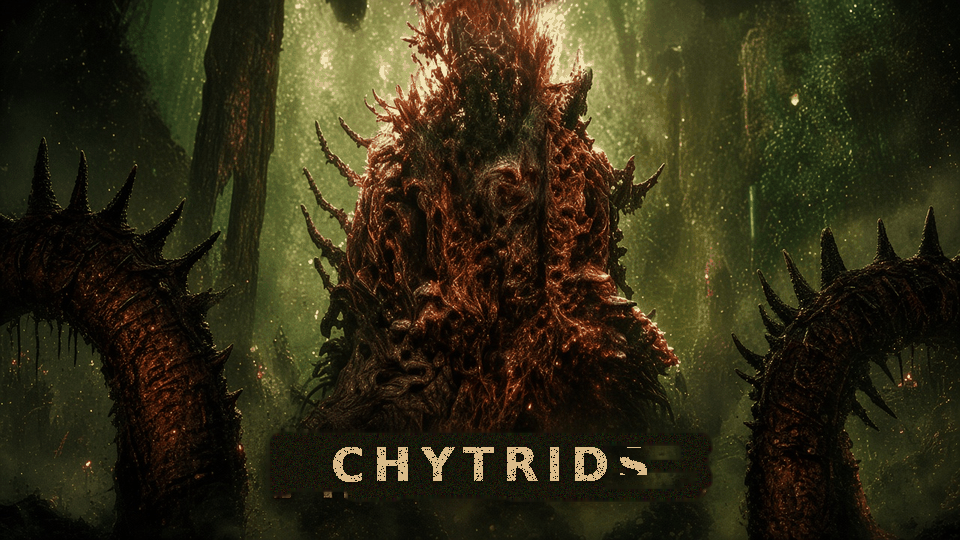
Technical data sheet (source): Nem TDoc 005 - Chytrids
Subject: Evolutionary Lifecycle of the Species Designated “Chytrids”
Author: Dr. Lirien Scael, Mycological Specialist
The Chytrids represent one of the most insidious biological threats humanity has encountered. What appears at first to be a simple fungal organism is in truth a highly adaptive colonial lifeform capable of rapidly consuming organic matter. They spread through both microscopic airborne spores and aggressive structural colonization, converting entire sections of ships and stations into grotesque fungal gardens within days.
Perhaps most alarming is their affinity for any environment designed to sustain plant life. Agricultural worlds, hydroponics bays, and greenhouse facilities act as perfect incubators for the Chytrids. Once introduced to such a setting, their growth rate becomes nearly exponential, often overwhelming containment efforts before the infestation is even detected. What would normally take weeks to spread through a starship can consume an entire greenhouse complex in under forty-eight hours.
Key Environmental Hazards
Blight Nectar / Slime
A thick, bioluminescent emerald-green gel with a sickly sweet odor. It coats surfaces in a slippery sheen and serves as both a nutrient base and a marker for further fungal growth.
Bombyx Spores
Dull, ashen puffs of sickly grey-white threads that drift silently through the ship. They glow with a cold, corpse-blue luminescence and move with unnatural agency — floating against air currents and deliberately drifting toward living targets. Their haunting, hypnotic movement is difficult to look away from.
Mycotic Hemorrhage / Contaminant
Infection occurs when spores are inhaled or absorbed through contact with slime. A single spore causes mild symptoms. A second spore infection results in immediate death, after which a Germinator erupts from the corpse.
Lifecycle Stages
Stage 0 – The Verdant Sepulcher / Nest
At the heart of every major infestation rises the Verdant Sepulcher — a colossal, self-created fungal cathedral of towering iridescent plates and writhing tendrils. Thick rivulets of Blight Nectar slowly drip down its grotesque architecture, filling the air with a sickly sweet stench. Multiple Anther Ovisacs hang from the ceiling and walls like grotesque, swaying fruit, their fleshy surfaces pulsing with latent life. Bioluminescent veins cast an eerie emerald glow across the chamber, transforming the entire structure into a breathtaking yet nightmarish monument of fungal perfection. To stand within the Nest is to witness something both majestic and deeply wrong — a living tomb that has claimed the surrounding space as its own body.
Stage 1 – Anther Ovisacs / The Egg
Large, bulbous, fleshy flower-like structures that bloom throughout the Nest. Their heavy petals slowly pulse with inner life, each crowned with a swollen, glistening central organ that throbs like a beating heart. These grotesque blooms hang in clusters from the walls and ceiling, their surfaces slick with Blight Nectar, waiting silently for the moment they will release their deadly payload.
Stage 2 – The Germinator
Puffball-like fungal growths covered in thick, flexing vines. When triggered, the vines constrict and violently pulse the main body, expelling large clouds of spores into the surrounding area. These are the primary engines of contamination and spread.
Stage 3 – Mycelium
The final and irreversible stage of infestation. When a room falls to Mycelium, every surface — walls, floor, ceiling, even machinery — is devoured and reborn as dense, fibrous fungal mats. The original structure ceases to exist, completely overwritten by the living tissue of the Chytrids. At this point the room no longer belongs to humanity. It has become part of their kingdom.
Stage 4 – Stinkhorn / Adult
The basic mobile form of the Chytrids. Fast, aggressive fungal horrors that serve as the Queen’s primary weapons. When the Queen senses danger, she dispatches these twisted, slime-dripping creatures to hunt down intruders. The further the Stinkhorns roam from their mother, the more vulnerable she becomes.
Stage 5 – Deathcaps / Breeder
A large, stationary turret-like fungal growth. It has a thick, fleshy stalk with a wide, bell-shaped cap on top that constantly releases clouds of spores into the air. It’s one of the more dangerous stationary forms — very hard to destroy and extremely effective at spreading contamination across wide areas.
Stage 6 – The Coma Nidus / Queen
A massive, pulsating fungal womb and the true heart of the infestation. Though she is ambulatory and capable of moving through the facility, she periodically returns to the Nest to feed and reproduce. She is constantly protected by a living shield of Stinkhorns. When threats appear, she sends her guardians out to eliminate them, willingly sacrificing her own defense in exchange for deadly reach.
End of Report
First-hand Account 1 – Nemesis Dalton’s Vigil
This is Engineer Orlando Korr, Deck 7.
It started with the vents.
These dull, grey puffs of fluff started floating out, drifting against the airflow like they were hunting for us. One latched onto a guy who had a small cut on his hand. Six hours later he was dead and a gelatinous cube was growing out of his chest.
Now the whole ship is turning green. The walls are pulsing. I can hear the vines growing through the ceiling panels above me. We tried burning them out. It only made the spores explode everywhere.
I’ve locked myself in the auxiliary control room. The spores are already drifting under the door.
If anyone finds this recording… don’t board this ship - Just burn it.
First-hand Account 2 – Operation Cinderfall, Uncharted Forest World
This is Captain Reid Valcourt, 7th NACSS, Biohazard Suppression Unit.
The fight was brutal. The Stinkhorns came at us in waves, pouring out of every crevice in the swamp. We lost twelve men just trying to reach the Nest. The air was so thick with spores that our visors kept fogging up. By the time we got to the Coma Nidus, we were down to half strength.
We burned that fucking thing anyway.
Flamethrowers on full. Napalm grenades. We cooked it for twenty straight minutes until nothing was left but ash and melted slime. We thought we were done.
Then we found the trail.
A twenty-foot-wide path of absolute destruction cut straight through the forest for miles. Trees shattered, ground crushed in rhythmic waves. Whatever made that trail was the size of a Mack truck. We had three Scorch Hawks running perimeter, scorching any trace of spores in the air. Two of them suddenly broke formation and flew straight down the trail after something.
We never saw what happened. All we found were the twisted, mangled remains of two drones — wrapped so tightly in thick fibrous vines that they were literally crushed. One was still smoking.
Whatever made that trail… it ripped two fully armed Scorch Hawks out of the sky and strangled them to death. We followed the trail to the cliffs. It just kept going down the rock face.
I don’t know what the hell we were actually hunting out here.
But I’m not convinced we killed the real monster.
Third-hand Account – Laboratory Analysis
This is Dr. Elias Brin, Senior Mycologist, Exobiology Division.
The samples Captain Valcourt recovered from the trail have been analyzed.
The hardened husk fragments, thorns, and fibrous strands are all genetically identical to the Chytrid strain eradicated during Operation Cinderfall. Carbon dating on the material puts this organism between five and six hundred years old — meaning it existed long before humanity ever left Earth.
The size of the trail suggests an entity of truly massive scale. The fact that it was able to rip two Scorch Hawks out of the air and constrict them with enough force to crush military-grade drones is… unsettling.
I am formally proposing the existence of a previously undocumented apex form of the Chytrids.
I am designating this entity Stage 7 – the Briar Athir / King.
While we have never observed it directly, the evidence is now undeniable. Something ancient, something enormous, and something highly mobile is moving through the galaxy wearing the same fungal signature we thought we understood.
If the Briar Athir exists, then every Chytrid infestation we have previously declared neutralized must be reevaluated.
We may not be burning out an infestation.
We may simply be pruning it.